
Spray Foam Insulation in Plano TX
A hot upstairs room does not automatically mean the attic needs spray foam. Insulation gaps and duct problems can produce similar symptoms. Stone Drywall Solutions provides spray foam insulation in Plano with attention to those differences. Our team has over 20 years of experience in drywall and finishing.
Our insulation installers review the roof space and its connection to the living areas before recommending a scope. That helps identify where insulation may improve the building and where other work is needed.
Call 469-999-8302 to discuss spray foam insulation for your Plano property.
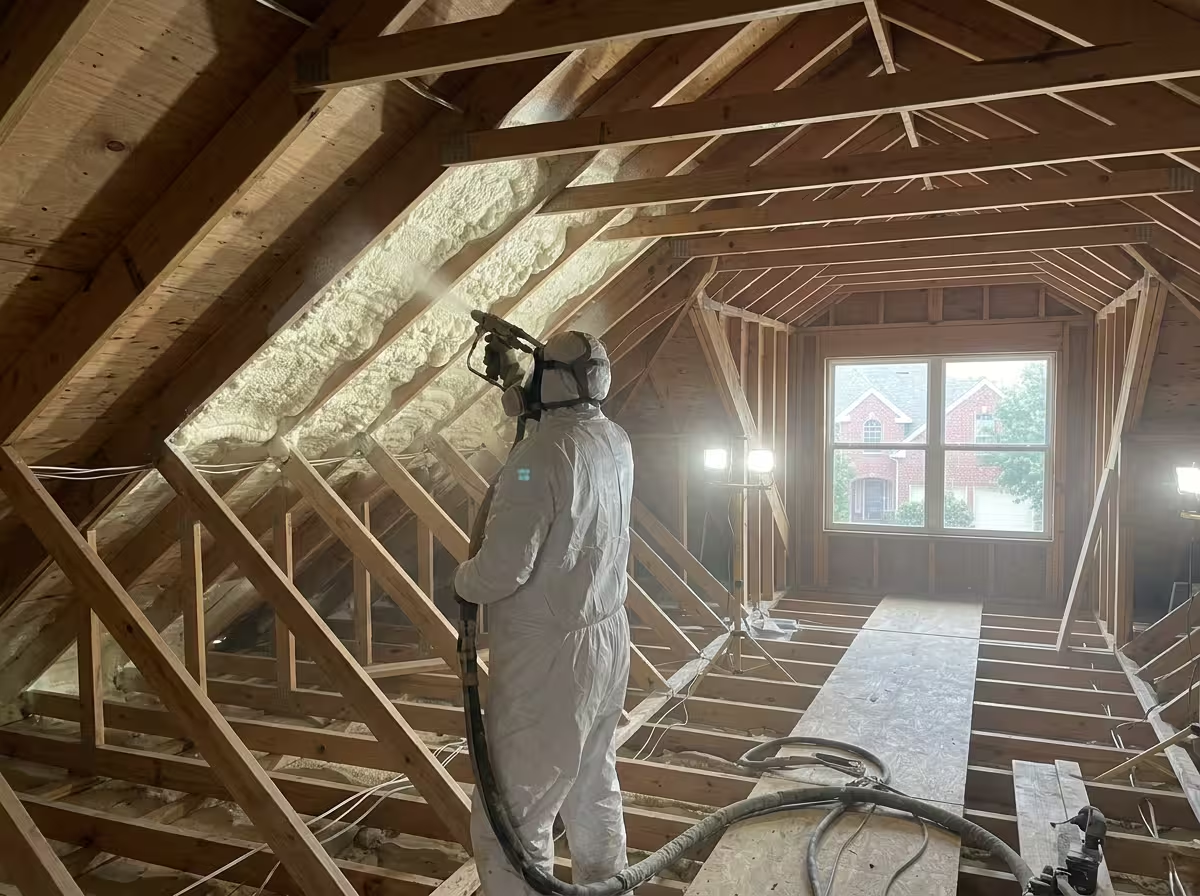
Our Spray Foam Insulation Services in Plano, TX
- Assembly assessment. The proposed area is reviewed alongside moisture behavior and existing construction.
- Product choice. Foam type and application depth follow the reviewed building assembly.
- Attic and roofline areas. Access, ventilation design and nearby equipment are considered before spraying.
- Wall cavities. Open wall areas are included where the project design calls for spray foam.
- Underfloor areas. Raised-floor work begins with an assessment of access and moisture.
- Protection and occupancy. Masking, restricted areas and ventilation are established before application.
- Coverage review. Our installers review the application before concealment and provide return-to-use instructions.
Foam type, thickness and protective layers follow the assembly requirements. Existing leaks and moisture problems need correction first.
Spray Foam Insulation for Plano’s Two-Story Homes and Complex Rooflines
Larger homes in West Plano and Willow Bend can contain several connected attic sections. Vaulted ceilings and intersecting rooflines may leave narrow spaces above upper bedrooms. These areas are not always visible from the main attic opening. The assessment needs to account for the entire proposed insulation boundary.
Finding Gaps Between Roof and Ceiling Sections
A well-insulated central attic does not guarantee coverage over every room. Framing changes can leave overlooked cavities near slopes or transitions. Access limitations should be identified before pricing. Spray foam cannot be assumed to fill a hidden space correctly when the installer cannot assess it.
Air sealing needs to connect across those changes in shape. A missed opening can allow air around the insulation. The plan should identify how walls meet sloped ceilings and adjoining attic sections. That continuity matters as much as the depth applied in an easy-to-reach area.
Comparing Attic-Floor and Roof-Deck Approaches
Insulating a vented attic floor keeps the main attic outside the home’s conditioned enclosure. Ceiling penetrations need air sealing while the intended roof ventilation remains functional. Existing ducts may still sit in a hot or cold space. That does not make the approach unsuitable, but it affects the broader assessment.
A roof-deck application changes the intended enclosure. It can bring the attic inside an unvented system when the assembly is properly designed and completed. Vent treatment and humidity control need to follow that design. Spraying beneath the roof alone does not automatically create a conditioned attic.
Any fuel-burning appliance in the affected attic needs qualified review before the ventilation arrangement changes. Equipment that relies on attic air cannot simply be enclosed without assessment. HVAC and combustion requirements should be resolved before installation. The insulation plan must fit the equipment or include necessary changes.
Evaluating Attic Spray Foam for Plano Homes With HVAC Ductwork Above Living Areas
Attic temperatures can increase heat transfer through ducts. Air leaks from the duct system add another problem. Attic spray foam insulation may change the environment around the equipment, but it does not repair loose connections. Inspect the distribution system before deciding which improvement will provide the most value.
Checking Duct Sealing and Existing Insulation
Disconnected or leaking ducts should be repaired directly. Duct insulation also needs checking for gaps and damage. These defects can remain after roof-deck foam is installed. Addressing them first helps avoid using a larger insulation project to compensate for a correctable mechanical problem.
The existing attic-floor insulation needs assessment too. Disturbed sections may leave rooms poorly protected even where the overall depth appears adequate. Targeted air sealing and conventional insulation improvements may be suitable. The recommendation should follow the findings rather than assume foam is always the next step.
Understanding the Benefits and Limits of Roof-Deck Foam
Bringing ducts inside a properly designed conditioned enclosure can reduce their exposure to outdoor temperature extremes. The benefit depends on the existing system and the completed design. It does not guarantee a specific reduction in utility costs. Household use and HVAC operation still influence the outcome.
Humidity control must remain part of the plan. An unvented attic needs an appropriate way to manage moisture. Simply making the space less leaky does not settle that question. The design should explain how attic conditions will be controlled after the work.
Open cell spray foam insulation and closed cell spray foam insulation differ in vapor behavior and R-value per inch. The right choice depends on the roof assembly and available space. Our spray foam technicians compare documented product performance. Do not select a foam solely because one option is denser.
Our Spray Foam Insulation Process For Plano, TX
- Assembly assessment. Our insulation installers review the assembly, moisture conditions and nearby equipment before defining the proposed application areas.
- Materials and protection. Foam type, depth and protection requirements follow the reviewed construction. Existing leaks and unsuitable substrate conditions are identified before spraying.
- Occupancy arrangements. Work-area restrictions, ventilation and product-specific re-entry requirements are established before application. Occupied adjoining areas are considered in that plan.
- Isolation and application. Access is controlled while the foam is applied in line with product requirements. Adjacent surfaces and equipment are protected within the agreed scope.
- Coverage and re-entry review. Our spray foam technicians review coverage before concealment and provide the applicable return-to-use instructions. Remaining protection requirements are explained at handover.
Why Choose Stone Drywall Solutions for Spray Foam Insulation
- Insulation tied to the assembly. Coverage follows the building’s construction and moisture behavior rather than a generic whole-house package.
- Occupancy arranged before spraying. Our team establishes application restrictions and product-specific re-entry guidance in advance.
- Established property-service experience. The project is supported by a bonded and insured local company with over 20 years of broader drywall and finishing experience.
Our Previous Work
Complex rooflines and attic equipment call for a property-specific insulation review. Use our previous-work gallery to discuss your wider Plano renovation, then we will assess the proposed foam areas and explain the assembly details.
Review Your Insulation Options in Plano
Call our spray foam team at 469-999-8302 with the areas you want insulated and the access available. Our insulation installers review roofline changes and attic equipment access before selecting the application areas.
Spray Foam Insulation Questions and Answers
A complex roofline creates more transitions and restricted spaces than a simple attic. Foam type, depth and equipment protection change both material and labor needs. The price follows those details instead of one rate for every attic square foot.
Area, access, preparation and application depth affect the installation schedule. Ventilation and re-entry requirements are product-specific and can extend beyond application itself. We establish those restrictions before the space is scheduled for use again.
No. Leaks, later alterations and damaged areas still need attention. Long-term performance depends on correct installation and a sound building assembly. Inspection and equipment access must remain available, and no universal energy-saving percentage is promised.
Not by itself. Airflow and return-air issues need HVAC assessment. Insulation should address the building enclosure alongside any necessary mechanical repairs.
That depends on the complete roof design. Vented and unvented assemblies use different approaches. Our insulation team follows the reviewed assembly rather than deciding vent treatment independently from the roof and ventilation plan.
Plano, TX Services
Transform Your Space with Expert Craftsmanship
Stone Drywall Solutions is your trusted partner for all drywall and painting needs. Contact us today for a free consultation and let us bring your vision to life with quality services you can rely on.