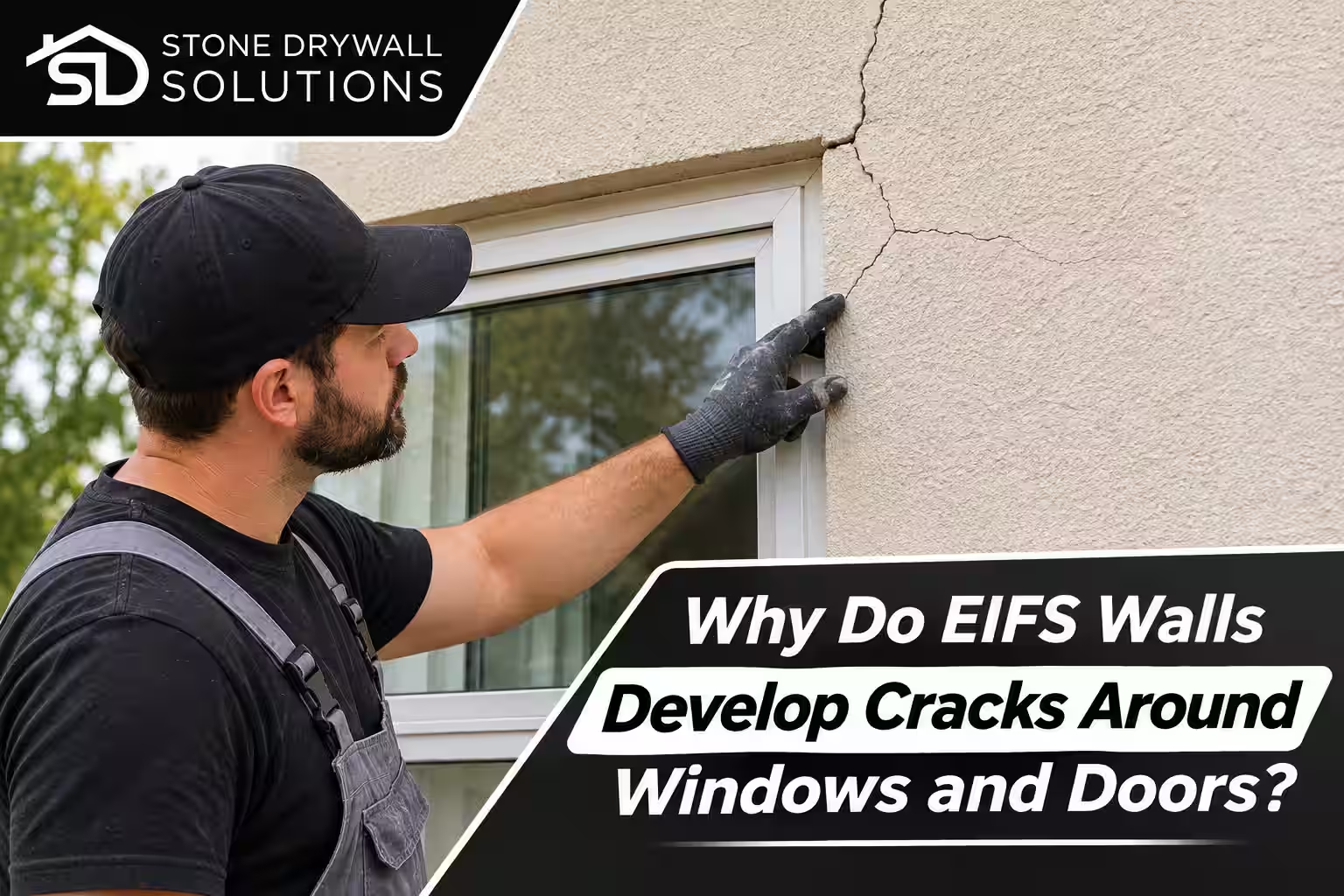
Cracks appearing near the corners of windows and doors can be an early indication that an exterior wall system is experiencing movement or installation-related stress. Some remain minor surface defects, while others develop alongside moisture intrusion or deterioration beneath the finish.
EIFS cracks around windows commonly result from differential building movement, insufficient reinforcing mesh, poorly designed sealant joints, or problems with flashing and water management. Corners are particularly vulnerable because stresses concentrate where the wall surface changes direction around an opening.
The appearance of a crack alone cannot establish how serious the problem is. Its location, direction, width, and surrounding conditions help determine whether a localized repair is appropriate or the underlying exterior wall assembly requires further investigation.
Why Are Window and Door Corners Vulnerable to EIFS Cracking?
An Exterior Insulation and Finish System (EIFS) typically combines insulation board, a reinforced base coat, and a textured finish coat. Some assemblies also incorporate a drainage plane and weather-resistive barrier behind the insulation. These components must accommodate movements between the exterior cladding, supporting wall, and adjacent building materials.
Window and door openings interrupt the otherwise continuous wall surface. Their corners create concentrated stress points, particularly when the wall framing or surrounding materials move. Cracks frequently begin at these corners and extend diagonally into the finished surface.
This pattern does not automatically indicate structural damage. However, it can suggest that the EIFS reinforcement or movement accommodation needs closer examination. The EIFS Industry Members Association (EIMA) addresses opening reinforcement and joint detailing in its installation guidance because these locations require particular attention during construction.
How Does Building Movement Cause EIFS Cracks?
Different building materials respond differently to temperature changes, loads, and moisture conditions. While EIFS contains flexible components, it cannot accommodate unlimited movement without properly designed joints and reinforcement.
Differential Movement Around Window Frames
Window frames, wall framing, and exterior cladding may expand or contract at different rates. For example, aluminum window frames can respond relatively quickly to temperature changes, while the surrounding wall assembly may move differently.
If the transition between the frame and EIFS is too rigid, movement can transfer stress into the reinforced surface. The resulting EIFS wall cracks may appear near window corners or along the perimeter where the two materials meet. Dallas buildings experience seasonal temperature changes and strong summer heating, making appropriate movement accommodation relevant to exterior cladding performance.
Substrate Movement and Building Settlement
The supporting wall can also contribute to cracking. Framing deflection, substrate movement, or building settlement may place additional stress around openings. A window or door frame that shifts relative to its surrounding wall can create concentrated forces at the EIFS corners.
If cracks continue to widen or reappear after repair, investigating the supporting assembly may be necessary. The important distinction is whether the damage comes from limited movement within an otherwise sound system or an ongoing condition that a surface repair cannot accommodate.
Can Improper Reinforcing Mesh Cause Cracks Near Openings?
Yes. Reinforcing mesh helps distribute stress through the EIFS base coat, reducing the likelihood of localized cracking. At window and door corners, standard field reinforcement may not provide sufficient protection without additional detailing.
Missing Diagonal Reinforcement
EIFS installation standards require additional diagonal reinforcing mesh at the corners of wall openings. This reinforcement helps distribute stress away from the corner rather than allowing it to concentrate along a narrow line. ANSI/EIMA 99-A-2017 specifies diagonal mesh reinforcement of at least 9 by 12 inches at openings such as windows and doors. Cracking may occur when installers omit the reinforcement, use insufficient coverage, or position the mesh incorrectly.
Incorrect Insulation Board Layout
Insulation board joints should not terminate directly at window or door corners. When board joints align with these stress points, movement can contribute to cracking through the EIFS lamina, which is the reinforced base coat and finish assembly.
Proper installation generally uses continuous, L-shaped insulation board sections around opening corners, along with the manufacturer’s required reinforcing details. Repairing this type of defect may require replacing the affected insulation and reinforcement rather than simply covering the visible crack.
Why Do EIFS Sealant Joints Fail Around Windows and Doors?
The transition between EIFS and a window or door frame usually requires a properly designed sealant joint. Its purpose is to accommodate movement while helping maintain a weather-resistant connection between different materials.
Insufficient Joint Width and Movement Capacity
A joint that is too narrow may not accommodate the anticipated expansion and contraction. As movement occurs, the sealant can stretch beyond its intended capacity, separate from the adjoining surfaces, or transfer excessive stress into the EIFS base coat.
EIMA’s July 2024 technical guidance discusses the importance of joint width, sealant flexibility, and material compatibility. Although a three-quarter-inch joint is common in some EIFS applications, the appropriate dimension depends on the system, expected movement, and manufacturer requirements.
Sealant Adhesion and Backer Rod Problems
Sealant performance also depends on proper surface preparation and joint construction. Closed-cell backer rod is commonly used to control sealant depth and prevent unwanted three-sided adhesion. Without appropriate backing, sealant may bond to surfaces that restrict its ability to stretch.
Incompatible products can also cause EIFS sealant joint problems. ASTM C1481 provides guidance for sealants used with EIFS, while ASTM C1382 evaluates sealant adhesion to EIFS materials under different environmental conditions.
Not every general-purpose caulk is suitable for an EIFS joint. Even when considering professional window and door caulking services, EIFS-specific material compatibility and joint design must be confirmed before work begins.
How Can Water Intrusion Make EIFS Cracks Worse?
A crack can provide a potential path for water, particularly when it occurs alongside failed sealant or defective flashing. However, not every EIFS crack indicates moisture intrusion. The concern becomes greater when water can enter the assembly and cannot drain or dry as intended.
Window Flashing and Weather Barrier Defects
Flashing around window heads, jambs, and sills helps direct water away from vulnerable connections. In drainage EIFS, properly integrated flashing and weather-resistive barriers work with the drainage plane to manage water that enters behind the exterior finish.
Incorrect flashing installation, poor weather barrier continuity, or blocked drainage paths can allow moisture to reach sensitive underlying materials. Over time, prolonged moisture exposure may contribute to substrate deterioration, loss of adhesion, or localized separation of EIFS components.
Why Surface Sealing May Not Stop a Leak
Water visible near a window does not necessarily enter through the nearest crack. It may originate above the opening and travel behind the cladding before becoming visible indoors. Applying sealant directly over an exterior crack without identifying the entry point can leave the actual leak unresolved. An appropriate investigation considers the surrounding window assembly, sealant transitions, flashing, and drainage details together.
How Can You Tell Whether an EIFS Crack Is Serious?
A small, stable surface crack may be primarily cosmetic, but certain conditions warrant further investigation.
| Visible Condition | What It May Indicate |
| Fine, isolated crack with no other symptoms | Localized finish deterioration or limited movement |
| Diagonal crack extending from a window corner | Concentrated stress or reinforcement problems |
| Separation between EIFS and the window frame | Sealant adhesion failure or joint movement |
| Repeated cracking after previous repairs | Unresolved movement or installation defects |
| Cracks accompanied by interior water stains | Possible moisture intrusion requiring investigation |
| Bulging, soft areas, or loose EIFS | Potential deterioration or loss of adhesion |
These observations are diagnostic clues, not definitive conclusions. EIFS cracks accompanied by moisture, progressive widening, or visible separation deserve professional assessment. Property owners should avoid probing damaged areas aggressively because doing so can disturb the cladding or create additional openings.
What Should an EIFS Inspection Include?
A useful EIFS wall inspection examines more than the visible finish. The goal is to determine whether the cracking is limited to the surface or connected to problems within the wall assembly.
An assessment may include:
- Documenting crack patterns: Record the position, direction, approximate width, and extent of each crack.
- Checking perimeter sealants: Look for separation, deterioration, improper joint geometry, and incompatible repairs.
- Reviewing opening details: Examine accessible flashing, window transitions, and drainage provisions.
- Assessing movement: Determine whether the window frame, substrate, or surrounding wall shows signs of continuing displacement.
- Investigating suspected moisture: Where conditions warrant it, a qualified building-envelope professional may recommend appropriate moisture testing or limited exploratory openings.
Inspection findings should guide the repair scope. A contractor should also identify the existing EIFS manufacturer and system when possible. Mixing incompatible repair components can affect adhesion, appearance, and long-term performance.
How Are Cracks Around EIFS Windows and Doors Repaired?
The correct EIFS crack repair method depends on what caused the damage. For an isolated surface defect with sound underlying materials, a manufacturer-approved localized repair may be sufficient. Cracks caused by missing reinforcement or damaged insulation typically require more extensive work.
The affected section may need to be removed so the substrate can be examined, new insulation fitted, and reinforcing mesh embedded into the base coat before refinishing. Dryvit’s EIFS repair guidance specifically addresses cracks at window and door corners and emphasizes identifying the cause before repairing the affected materials.
Where joint failure is responsible, the repair may involve reconstructing the perimeter transition using appropriate joint dimensions, backing materials, and compatible elastomeric sealant. If moisture has damaged the supporting wall, those conditions must be addressed before restoring the cladding. For projects involving substantial EIFS replacement or installation, exterior insulation and finishing systems in Dallas, TX provide a relevant service option.
How Much Does EIFS Crack Repair Cost in Dallas, TX?
EIFS repair costs depend on whether the work involves a localized crack, failed perimeter sealant, damaged reinforcement, or moisture-related deterioration. Published 2026 Dallas-area pricing information places synthetic EIFS repair or partial replacement at approximately $15 to $55 per square foot.
A small repair may still involve minimum labor charges, access equipment, and finish matching. Repairs around windows can become more expensive when flashing or underlying wall materials must be replaced.
Pricing note: These are estimated market prices, not confirmed business rates. Actual costs depend on damage severity, repair size, material selection, accessibility, labor, and required moisture or substrate repairs. A written, itemized quote after an on-site assessment is the most reliable way to determine the actual repair cost.
How Can EIFS Cracking Around Openings Be Prevented?
Preventing recurring cracks starts with correct installation details and periodic inspection of vulnerable transitions.
Building owners should pay particular attention to:
- Reinforcing mesh placement at window and door corners during installation
- Adequate movement joints between EIFS and adjoining materials
- Manufacturer-approved sealants and compatible joint backing
- Properly integrated window flashing and drainage provisions
- Deteriorating sealant before gaps become substantial
- Previously repaired corners where cracks begin to reappear
Periodic visual inspections are especially useful following exterior renovations, window replacement, or reported water intrusion. When evaluating an installation contractor, ask how the proposed system handles opening reinforcement, movement joints, and water management. Stone Drywall Solutions provides EIFS installation services in Dallas. The company states that its team has over 20 years of experience in drywall and related finishing work.
Frequently Asked Questions
Are Hairline Cracks Around EIFS Windows Always a Problem?
Not necessarily. A fine, stable crack may involve only the exterior finish. However, its location near an opening means the surrounding reinforcement and sealant condition should be considered before deciding it is cosmetic.
Can EIFS Cracks Be Fixed With Regular Caulk?
Regular household caulk is not automatically suitable for EIFS. Sealants must accommodate the expected joint movement and be compatible with the EIFS system. The product and repair method should follow manufacturer guidance.
Why Do EIFS Cracks Return After Repair?
Recurring cracks may indicate that the original movement, reinforcement defect, or joint problem was never corrected. Reapplying finish material over the same stress point often fails to address the underlying cause.
Does Every EIFS Crack Require Removing the Insulation?
No. Minor surface defects may be repairable without removing the insulation. Removal becomes more likely when reinforcing mesh, insulation board, substrate, or concealed moisture conditions require investigation and corrective work.
Address EIFS Cracks Before Further Damage Develops
Cracks near windows and doors can result from normal material movement, inadequate reinforcement, failed sealant joints, or defects in the surrounding wall assembly. The appropriate response depends on the crack’s behavior and the condition of the materials beneath it. Identifying the cause before repairing the finish helps avoid repeated failures. For exterior insulation and finishing system installation inquiries in Dallas, TX, contact Stone Drywall Solutions or call 469-999-8302 to discuss your project.