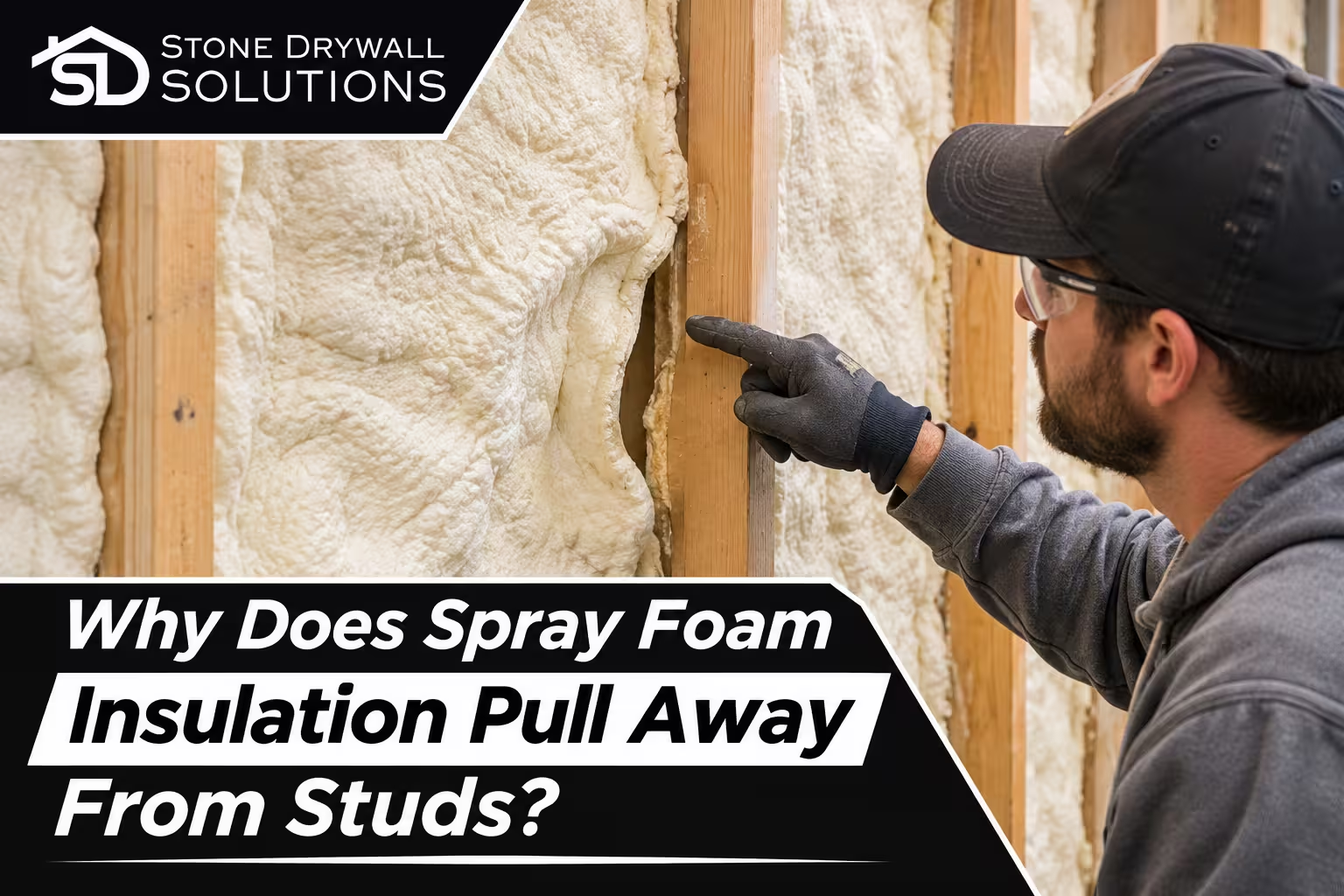
Spray foam insulation is supposed to bond firmly to wall studs, sheathing, and other suitable building surfaces. However, some homeowners discover that the foam has shrunk, cracked, or separated from the wooden framing after installation. The result is often a noticeable gap running along one or both sides of a stud.
Spray foam pulling away from studs usually happens because of incorrect application temperatures, excessive foam thickness, poor substrate preparation, or problems with chemical mixing. Moisture on the wood and improper spraying techniques can also prevent the foam from forming a reliable bond.
Not every small gap means the entire insulation system has failed. However, widespread separation can compromise insulation continuity and air sealing. Identifying the cause helps determine whether localized correction is sufficient or a larger installation problem needs professional attention.
What Happens When Spray Foam Pulls Away From Wood Framing?
Spray polyurethane foam (SPF) is applied as a liquid mixture that expands and develops into an insulating material. During installation, it should adhere to compatible surfaces and remain dimensionally stable after curing. When something goes wrong, the foam may separate from the studs or contract inward, leaving visible spaces along the framing. Two different conditions can produce this appearance.
Foam shrinkage occurs when the material changes dimensions after application. As it contracts, the insulation may pull away from the surrounding wood.
Adhesion failure occurs when the foam does not bond properly to the substrate. The material may retain much of its original shape but separate from the framing.
Both conditions can create unwanted openings, although their causes and repair requirements may differ. The Spray Polyurethane Foam Alliance (SPFA) explains that improperly installed foam, particularly certain closed-cell products, can shrink away from structural members. Isolated shrinkage may occur, but extensive separation is considered a defect requiring correction.
What Causes Spray Foam Insulation to Shrink or Separate?
Several factors influence how spray foam expands, bonds, and cures. Installation conditions must remain within the manufacturer’s specifications to achieve the intended performance.
1. Moisture or Contamination on Wooden Studs
Spray foam requires clean, dry surfaces for reliable adhesion. Wood framing containing excessive moisture can interfere with bonding. Water may affect the chemical reaction, while changes in the wood’s moisture content can contribute to movement at the connection.
Dust, grease, oil, and construction debris can also prevent foam from adhering directly to the substrate. ASTM C1848, a standard practice for installing high-pressure spray polyurethane foam, indicates that wood substrates should typically have a surface moisture content no greater than 18%. The foam manufacturer’s requirements still take priority when they specify a different acceptable limit. Professional installers should measure wood moisture levels and inspect surface conditions before applying insulation.
2. Incorrect Foam and Substrate Temperatures
Spray foam components must be applied within the temperature ranges specified by their manufacturer. If the chemicals are too hot or too cold, the foam may not expand and develop the intended structure. The framing temperature matters as well.
Cold studs can interfere with initial bonding, while inappropriate chemical temperatures may affect the way the foam expands against the wood. Gaco’s technical guidance identifies excessive foam temperature, cold studs, and incomplete surface contact as possible causes of foam pulling away from framing.
In Dallas, hot attic conditions and temperature differences between indoor and outdoor spaces make actual substrate measurements especially important. Installers should verify surface and material temperatures rather than relying only on the outdoor weather forecast.
3. Improper Chemical Mixing and Equipment Settings
High-pressure spray polyurethane foam typically uses two chemical components, known as the A-side and B-side. These materials must be combined in the correct proportions using properly functioning equipment. Incorrect mixing ratios, unsuitable pressure, blocked spray gun components, or problems with material temperature can produce defective foam. The resulting material may become unusually brittle, soft, sticky, or dimensionally unstable.
Such conditions can contribute to spray foam adhesion failure, cracking, or shrinkage after application. Professional applicators are responsible for maintaining the equipment settings required by the specific foam system.
4. Applying Spray Foam Too Thickly
Spray foam generates heat as its chemical components react. This heat is part of the curing process. Applying excessively thick layers can trap heat inside the material. If temperatures rise beyond the intended range, the foam may develop an irregular cell structure, crack, or shrink. This is particularly relevant to closed-cell spray foam shrinkage.
Manufacturers establish maximum application thicknesses and cooling intervals between layers. These requirements vary by product. Applying additional foam before the previous layer has cooled sufficiently can also contribute to problems. Following the specified pass thickness helps control the reaction and reduce the risk of dimensional instability.
5. Poor Spray Technique and Incomplete Surface Contact
The applicator’s spraying technique influences how effectively foam bonds to framing. The spray pattern must reach the sides of the studs and other intended surfaces. When the applicator works at an unsuitable distance or angle, the foam may not adequately contact the wood before expanding. This can leave weakly bonded sections or gaps along the framing.
Uneven application may also produce inconsistent thickness across the cavity.Proper equipment operation cannot compensate for poor application technique, so installers must monitor coverage and bonding throughout the process.
How Can You Recognize Spray Foam Installation Defects?
Some problems become visible shortly after installation, while others are discovered during a later inspection.
Common warning signs include:
- Gaps along wooden studs: Foam has visibly separated from the framing.
- Cracks within the insulation: The cured material has split or developed irregular openings.
- Recessed foam edges: Insulation appears to have contracted away from the stud.
- Uneven coverage: Some sections contain substantially less foam than the intended design requires.
- Unusual material texture: Foam appears excessively brittle, soft, sticky, or deteriorated.
These conditions do not all have the same cause. A narrow opening may result from incomplete coverage rather than actual shrinkage. Likewise, an intentionally partially filled cavity should not automatically be mistaken for defective insulation. The original installation specifications help determine whether the visible condition meets the intended requirements. Photographing the affected cavities and documenting their locations can make subsequent professional assessment more useful.
Why Can Spray Foam Separation Affect Insulation Performance?
Spray foam is often selected because it can provide insulation and contribute to air sealing within an appropriately designed building assembly. When the material pulls away from framing, that continuous layer may become interrupted.
Unwanted Air Movement
A gap along a stud can create an unintended air pathway if it connects to other openings within the wall assembly. This can reduce the effectiveness of the intended air barrier. However, not every visible gap automatically produces significant air leakage. The effect depends on where the opening is located and whether other materials maintain air barrier continuity.
Reduced Thermal Performance
Gaps can also leave portions of the cavity with inadequate insulation coverage. Heat transfer may increase at these locations, reducing the effectiveness of the overall assembly. The performance impact depends on the extent of the separation, the insulation thickness, and the surrounding building materials.
Possible Condensation Concerns
Air movement through unintended openings can carry moisture into parts of the building envelope. Under suitable temperature and humidity conditions, that moisture may condense on cooler surfaces.
Widespread spray foam insulation gaps therefore deserve evaluation, particularly when the assembly relies on foam to control both heat transfer and air movement.
When Does Spray Foam Separation Need Professional Inspection?
A small isolated defect may require less extensive correction than foam that has detached throughout several wall cavities. However, the size of a gap alone does not explain why it occurred.
Professional assessment is particularly important when:
- Multiple studs show similar separation.
- Cracks extend through substantial portions of the insulation.
- The foam has unusual texture, color, or persistent odors.
- The material continues changing shape after installation.
- The installation shows inconsistent coverage across several cavities.
A qualified spray foam professional can review the foam condition, substrate moisture, installation specifications, and available application records. Depending on the findings, appropriate adhesion testing or additional investigation may be necessary.
Homeowners should avoid cutting, pulling, sanding, or removing questionable spray foam themselves. Disturbing improperly installed material can create dust or other potential exposure concerns. If the installation is recent, contacting the original contractor and requesting the product details and installation records is a reasonable first step.
How Is Spray Foam That Has Pulled Away From Studs Repaired?
The appropriate repair depends on whether the existing foam remains sound and properly bonded. For a limited defect, a qualified installer may be able to correct the affected section without replacing the entire insulation assembly. Where foam has widespread shrinkage, poor adhesion, or defective material properties, more substantial removal and replacement may be required.
A professional correction generally involves the following:
- Identify the cause: Determine whether the problem involves shrinkage, poor bonding, incorrect application conditions, or defective foam.
- Evaluate the affected material: Establish which sections remain sound and which require replacement.
- Check the substrate: Verify that the framing is dry, stable, and suitable for a new application.
- Correct installation conditions: Confirm proper equipment operation, material temperature, chemical mixing, and spraying requirements.
- Apply replacement insulation: Follow the manufacturer-approved procedure for the selected system.
- Inspect the completed work: Verify that coverage and adhesion meet the intended requirements.
Simply applying additional foam over visibly defective material may conceal the original problem without correcting it. For new installations or replacement work, spray foam insulation services in Dallas, TX are available through Stone Drywall Solutions.
How Can Spray Foam Pulling Away From Framing Be Prevented?
Preventing separation requires attention before, during, and after installation. The first step is proper substrate preparation. Wooden framing should be checked for excessive moisture, contamination, and unsuitable surface conditions. Installers must also follow the manufacturer’s recommendations for chemical storage, application temperature, equipment settings, and foam thickness.
During spraying, consistent technique helps maintain adequate contact between the foam and framing. For products requiring multiple layers, the specified cooling intervals should be observed. A final inspection should confirm that the foam remains properly bonded and that required coverage has been achieved.
For projects involving unfinished walls, inspecting insulation before drywall installation is especially valuable because concealed defects become more difficult to identify afterward. The article on what should be checked before drywall is installed also addresses framing condition, insulation coverage, and other preparations that should be completed before walls are closed.
Frequently Asked Questions
Is It Normal for Spray Foam to Shrink Slightly After Installation?
Some isolated shrinkage can occur. However, extensive gaps or widespread separation are not considered acceptable installation conditions. The affected foam should be evaluated to determine whether correction is necessary.
Does Spray Foam Pulling Away From Studs Mean the Entire Installation Must Be Replaced?
Not necessarily. Localized defects may be correctable without removing all the insulation. Widespread problems involving defective material or poor adhesion may require more extensive replacement.
Can Spray Foam Separate From Metal Framing Too?
Yes. Spray foam can experience adhesion problems on metal and other substrates if surfaces are contaminated, wet, or unsuitable for the selected product. Some materials require specific preparation or primers before application.
Can Detached Spray Foam Be Repaired With Canned Expanding Foam?
Canned foam should not automatically be used to correct defective professionally installed insulation. The original foam condition, material compatibility, and cause of separation should be evaluated before selecting a repair method.
Address Spray Foam Separation Before Closing the Walls
Spray foam pulling away from studs may result from improper application temperatures, moisture, poor surface preparation, excessive pass thickness, or chemical mixing problems. Correcting the underlying issue helps avoid repeated separation and supports the intended insulation performance. Stone Drywall Solutions provides spray foam insulation services in Dallas, TX. The company reports over 20 years of experience across its drywall, insulation, and finishing services. For spray foam installation inquiries, contact Stone Drywall Solutions or call 469-999-8302 to discuss your project.