
Drywall rarely fails in one dramatic way. It cracks at a corner, pops a nail head, sags in a ceiling, stains below a bathroom, or picks up a dent from a door. Each of those problems looks different, has a different cause, and calls for a different repair. Knowing the types of drywall damage in Dallas homes makes it easier to tell what is cosmetic, what is a warning sign, and what needs more than a tub of spackle.
This guide covers the most common drywall problems, what usually causes each one, how to read the warning signs, and when professional repair is the better route.
Why Drywall Damage Looks Different From Home to Home
Several local factors shape what shows up on walls and ceilings in North Texas. Clay soils expand when wet and shrink when dry, and that movement can put stress on a house over time. Hot, humid summers affect framing and slow drying after any leak. Homes also vary widely in age, from older houses with layers of previous repairs to newer builds with fast, builder-grade finishes.
None of that means every crack signals a foundation problem or every stain means a leak. It does mean that the pattern, location, and repeat behavior of damage carry as much information as the damage itself.
Drywall Cracks
Drywall cracks are the most common complaint, and they are not all the same.
Hairline Cracks
Thin cracks at door and window corners, along seams, or where walls meet ceilings are common. When they are narrow, under about an eighth of an inch, they are usually cosmetic. Typical causes include normal settling, humidity changes, and seams that were not taped or finished well. These cracks often return if they are only painted over, because the underlying seam or corner is still moving slightly.
Settlement and Movement Cracks
Some cracks point to more than a finish problem. Diagonal cracks wider than an eighth of an inch that radiate from the corners of doors or windows, doors that won’t close in any season, and windows that suddenly stop opening are worth a professional opinion before any cosmetic work. When several of these show up together, the issue may be structural, and patching the drywall won’t address it. This guide on how to prevent drywall cracks in Texas homes goes deeper on the causes and what slows them down.
Ceiling Cracks
Ceiling cracks often follow seams or run between fasteners. Loose fasteners, moisture, and movement in the framing above are common causes. A ceiling crack that grows, comes with a stain, or sits next to a sag should be treated as more than cosmetic, because leaks and loose board can both start this way.
Drywall Holes and Dents
Drywall holes vary from tiny to large:
- Small holes, under about half an inch, come from nails, screws, and hardware, and are filled with spackle or joint compound.
- Medium holes, half an inch to about six inches, often come from doorknobs and furniture impact, and are usually repaired with a reinforced patch.
- Large holes, over about six inches, come from major impacts, removed fixtures, or plumbing and electrical access, and need a supported patch or a new piece of drywall.
Wall dents are shallow compressions that haven’t broken through the paper. They are usually filled and feathered. Repairs look right when edges are blended, texture is matched, and the wall is primed and painted, which is where a professional drywall repair service in Dallas tends to make the biggest difference.
Nail Pops and Screw Pops
Nail pops appear as small bumps or cracked circles of paint where a fastener has pushed outward. Common causes include framing lumber shrinking as it dries, drywall that wasn’t firmly attached to the framing, fasteners of the wrong length, and warped or misaligned studs and joists.
Simply driving the fastener back in rarely fixes the problem. The usual repair adds a new screw an inch or two above and below the pop so the board is held firmly again, then fills and finishes the surface. A single pop is minor, but many pops in one room can point to a framing or fastening issue.
Damaged Seams, Tape, and Corners
Joints between drywall sheets are covered with tape and compound, and those seams are where many failures start. Damaged drywall seams show up as visible lines, ridges, or cracks that follow the joint. Peeling drywall tape looks like a bubble or a loose strip of paper, and it often means the tape was applied over too little compound or got wet.
Damaged corners are common on outside corners, where metal or paper-faced bead protects the edge. Impact from furniture, vacuums, and moving crews dents and crushes them. A small chip is a simple fix, but a crushed bead usually needs to be replaced to give a straight, solid corner.
Joint failure that repeats along the same seam often points to movement, moisture, or a poor original finish. Fixing only the visible surface without addressing the cause usually brings the crack back.
Water-Damaged Drywall
Water-damaged drywall is the type that deserves the most attention, because the visible damage is often smaller than the real problem. Common signs include:
- Water stains in yellow, tan, or brown rings
- Bubbling or peeling paint
- Soft, swollen, or crumbling board
- Warped or buckled sections
- A musty odor
- Stains that return after repainting
The EPA advises drying wet building materials within 24 to 48 hours to prevent mold growth, and fixing the source of the moisture so the problem doesn’t repeat. Painting over a stain does not repair drywall and hides a problem that may still be active. Drywall that has been wet for days, has softened, or smells musty may need to be cut out and replaced, and any visible growth should be assessed before the wall is closed up.
Sagging Drywall
Sagging drywall, most often on ceilings, deserves caution. Common causes include board that is too thin for the spacing of the framing above it, the weight of insulation pressing down on the panel, loose or missing fasteners, and moisture that has softened the board.
A sagging ceiling can also signal a leak above it, and water can collect in a bulge. A sag with a stain, a drip, or a musty smell should be checked for the source of the water before anyone pokes at it or tries to fix it. Cosmetic work over an active leak won’t last.
Surface and Texture Damage
Not all damage goes deep. Surface damage includes scraped paper, bubbles in paint, small tears, peeling paint, and areas where texture has been scraped off, sanded away, or poorly matched. Torn paper on drywall, if left exposed, can bubble when painted, so it generally needs to be sealed before finishing.
Texture damage matters more than it looks. A repair can be solid underneath and still show clearly if the texture doesn’t match the surrounding wall, particularly on ceilings under side light.
How One Type of Damage Leads to Another
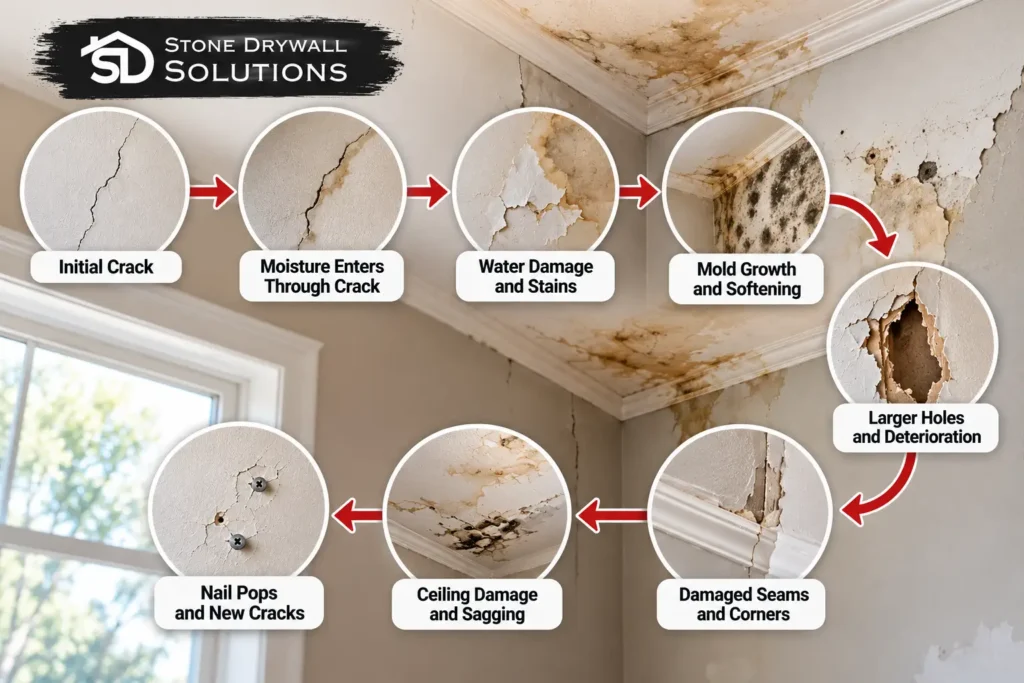
Drywall problems often overlap, and the first symptom is not always the root cause. A leak softens the board, which loosens fasteners, which pops nails and cracks seams. Framing movement opens a corner crack, which lets humid air reach the joint, which lifts the tape. A dent from a doorknob can break the paper, and a small tear left unsealed can bubble under paint.
That chain is why a repair that fixes only the visible part tends to fail. Tracing each symptom back to its cause, whether moisture, movement, loose fastening, or a poor original finish, is what keeps a repair from returning.
Which Damage Is Cosmetic and Which Needs Attention?
| Type of damage | Usually cosmetic when | Needs attention when |
| Hairline cracks | Narrow, at corners or seams | Wider than about an eighth of an inch, or growing |
| Diagonal cracks | Not applicable | Radiating from door or window corners, with sticking doors |
| Small holes and dents | Isolated, dry wall | Many in one area, or soft board around them |
| Nail pops | A few, occasional | Many in one room, or repeating after repair |
| Seam and tape damage | Minor, single joint | Repeating along the same seam, or with stains |
| Water stains | Old, dry, source fixed | Spreading, returning, soft, or musty |
| Sagging | Never | Any sag, especially with stains |
When to Call a Professional
Small nail holes and shallow dents are reasonable DIY jobs. Professional help is more useful for large holes, multiple damaged areas, failed tape, ceiling damage, water damage, texture matching, recurring cracks, and highly visible finishes. For a broader look at methods and what each repair involves, the complete guide to drywall repair in Dallas covers the process in detail.
Stone Drywall Solutions serves residential and commercial projects across the Dallas-Fort Worth area, with installation, repair, patching, taping, mudding, and texturing listed among its services.
Questions Homeowners Ask About Drywall Damage
Are cracks in drywall normal?
Hairline cracks are common, especially at corners and seams. Wider, diagonal, or repeating cracks, particularly with sticking doors or windows, are worth having checked.
Why do nails keep popping out of my drywall?
Common causes include framing shrinking as it dries, loose fastening, and warped framing. Re-driving the fastener rarely solves it, and adding new screws nearby usually works better.
How can I tell if drywall water damage is serious?
Soft, swollen, crumbling, or musty drywall, and stains that return after painting, are signs that the damage goes beyond the surface.
Can I just paint over a stain?
Painting hides the stain without fixing the cause or the damaged board. The moisture source has to be fixed first.
Get Drywall Damage Looked At Before It Spreads
Small problems are cheaper and simpler to fix when they are caught early. For a Dallas home with cracks, holes, seam damage, or water-stained walls and ceilings, contact the Stone Drywall Solutions team or call (469) 999-8302 to talk through the repair.